With support from Thieme Compliance, Luisenhospital Aachen has systematically digitized its admission and patient information processes, replaced paper-based workflows, and restructured its processes. A look at a transformation that makes a difference in everyday life.
Digitalization in hospitals is rarely a project that can be handled on the side. The processes are too complex, the requirements of the various professional groups too diverse, and the concern that familiar workflows might grind to a halt too great. At Luisenhospital Aachen, things turned out differently: Within a short period of time, both patient admission and patient information were digitized. Today, paper forms are largely a thing of the past.
Katharina Mohr, a project staff member in the Digitalization department and a registered nurse, and Jonas Fehling, a project manager on the executive board, have closely supported the project. In this interview, they discuss the initial situation, organizational changes in day-to-day operations, and the surprisingly high level of acceptance within the organization.
Ms. Mohr, Mr. Fehling, what was daily life like at the Luisenhospital in Aachen before digitization?
Mohr: Very paper-heavy. Admission and patient information meant: print, sign, pass on, scan again. Documents existed in physical form only once. If a file was in transit, you had to wait. And yes, sometimes documents simply couldn’t be found. That might sound like a minor issue, but in the day-to-day routine of a hospital, that’s exactly what costs time and causes frustration.
Fehling: On top of that, there was a certain stagnation in our operations. Many processes had evolved over the years and were never fundamentally questioned. At the same time, the Hospital Future Act created both pressure and motivation to finally and consistently drive forward the hospital’s digital transformation.
How did you go about making the transition?
Mohr: We started by working with Thieme Compliance to examine every single process: Where are documents created? Who needs them? What is duplicated? In the process, we quickly realized that some forms were outdated or redundant. For us, digitization wasn’t just about “replacing paper” – it was also about streamlining. One major advantage today is consolidation: Patients only need to provide certain information – such as allergies – once. Previously, this information was spread across multiple forms. Now it’s intelligently consolidated. This reduces the workload and makes the process much more convenient for patients.
Fehling: At the same time, we laid the technical groundwork. One practical question here was: How extensive does the hardware setup need to be? The interface to the HIS was also crucial, so that master data could be transferred automatically. In addition, we had to clarify: How do employees log in? How do we set up the password structure? Such questions may seem very specific, but they are essential for smooth operations.
When it comes to digital transformation projects, employee acceptance is often a critical issue. How was that for you?
Fehling: To be honest, better than expected. Of course, there was some skepticism at first. The classic response: “That’s how we’ve always done it.” But as soon as my colleagues saw how intuitive the applications are, that skepticism quickly faded.
Mohr: It was important to get the employees on board. We provided plenty of explanations, took questions seriously, and deliberately left room for feedback. And then came the crucial point: People realized that their day-to-day work would become easier. No more searching, no more scanning – everything is immediately available. Concerns about system outages also played a role. That’s why we defined clear emergency procedures.
Fehling: We actually had to use them once when there was a power outage in the city. That’s when our backup solutions kicked in—we used paper forms that were later updated digitally. But situations like that are extremely rare.
How did the pilot go?
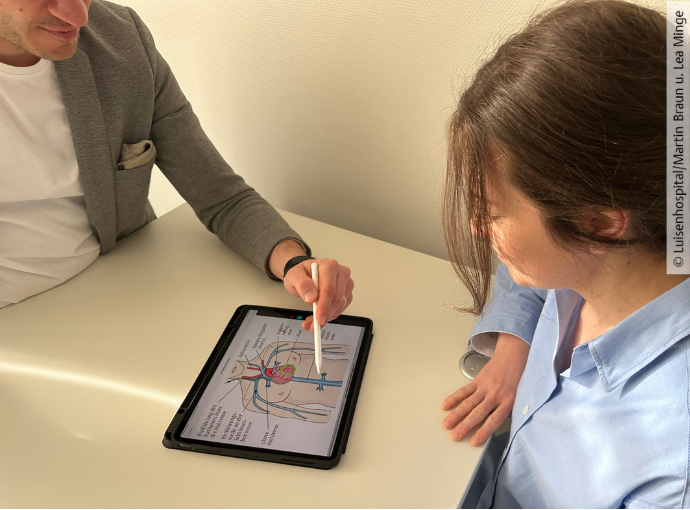
Mohr: We started with a pilot department in the premedication area. There, we trained the staff and tested the process. The training sessions were very hands-on, conducted directly on the system. Our colleagues were able to see firsthand how a digital informed consent process works: from accessing the record in the hospital information system (HIS) to processing it on a tablet and applying an electronic signature.
Fehling: After that, we deliberately scaled up quickly. No long testing phases – we moved into live operation step by step. Within a few weeks, the entire company had made the transition. That worked well because training and implementation were closely integrated.
How do patients react?
Mohr: Very positive. Many people think older adults are hesitant to use technology. Our experience has been exactly the opposite. There was one instance where an older patient explained to a younger patient how the tablet works. That really says it all. The interface is clearly structured, and users are guided by simple instructions. Many find this more convenient than paper. In addition, we offer the option to fill out forms in advance from home. This isn’t required, but it’s a service that’s well received.
What benefits do you see specifically in patient information?
Mohr: During a consultation, doctors can highlight or draw on the tablet. This makes many things much clearer. Photos can also be integrated directly, and everything is automatically included in the medical records.
Fehling: A great advantage is that it’s multilingual. Patients can read the content in their own language, while doctors can view the German version at the same time. This greatly improves clarity.
Has the way people work together within the company changed?
Fehling: Absolutely . In the past, you often had to wait for a file; today, multiple departments access the same information at the same time. This speeds up processes and creates transparency.
Mohr: And several intermediate steps are eliminated. What used to be printed, signed, and scanned is now done digitally.
Can the time saved be quantified?
Mohr: Not exactly. But you can clearly see that a lot of small steps are being eliminated.
Fehling: And it’s precisely these small steps that add up. Time is a scarce resource in the hospital. Everything we save here ultimately benefits the patients. On top of that, there’s the sustainability aspect: significantly less paper and a more modern public image.
Looking back on the project, what surprised you personally?
Fehling: The high level of acceptance. I had expected more resistance.
Mohr: And how naturally the patients use the tablets. That was really positive.
What advice would you give to other organizations planning similar projects?
Fehling: Digital transformation is a team effort. You need dedicated people in-house and a partner who thinks along with you. Our collaboration with Thieme Compliance was a key factor in our success. And you need to have the courage to rethink processes. Digital transformation is an opportunity to do things better, not just differently.
What’s next for the Luisen Hospital?
Fehling: Digitalization doesn’t end with this project. We will continue to optimize and explore new possibilities.
Mohr: To be specific, right now we’re purchasing more tablets. Demand within the organization is higher than expected. That’s actually the best sign that the solution has become part of everyday life.