
The Siloah St. Trudpert Clinic in Pforzheim has made its admissions and patient information processes future-proof: With support from Thieme Compliance, paper-based processes were phased out — creating tangible benefits for both patients and staff. Two perspectives on a successful transformation.
Piles of paper, search efforts, and unnecessary trips?
At the Siloah St. Trudpert Clinic in Pforzheim, all of that is now a thing of the past. In collaboration with Thieme Compliance, both the admission processes and the medical counseling procedures were restructured. The implementation took place in close coordination between the admissions department, medical staff, IT, and the software partner.
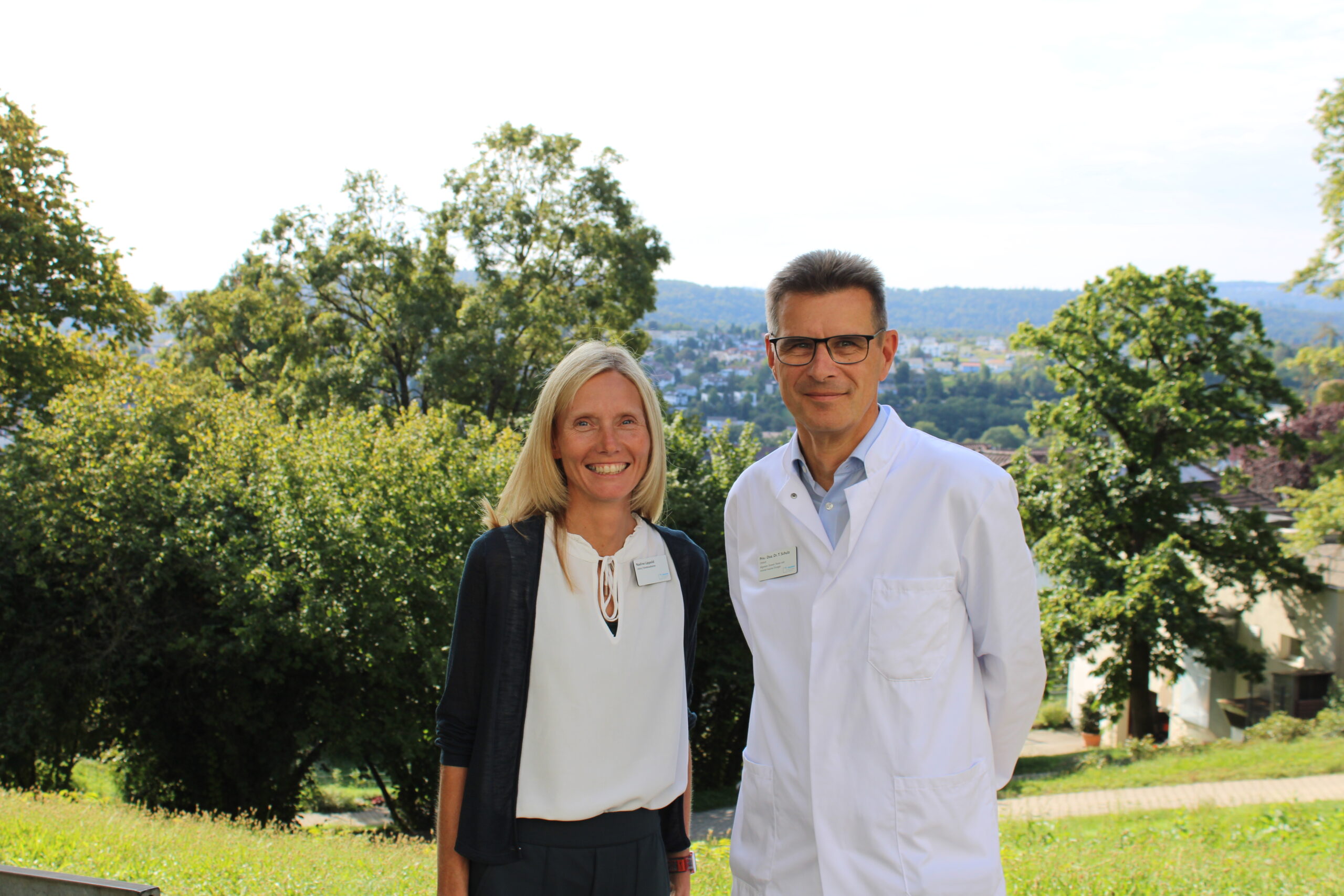
In this interview, Nadine Lippold, Head of Administrative Patient Admissions, and PD Dr. Tim Schulz, Chief of the Department of General, Visceral, Thoracic, and Minimally Invasive Surgery, discuss their motivations, specific procedures, and the impact on day-to-day clinical practice.
What was the deciding factor in opting for full digitization in the areas of patient admission and information?
Lippold: When I took over patient admissions in 2023, my first question was: How do we get all that paper out of the system? For each case, there was a folder containing numerous documents, ranging from the admission application to the release form to the agreement on optional services. Everything had to be printed, signed, archived, and, in some cases, scanned back in. I wanted to implement this in a seamless, digital, and transparent way — so I brought the issue directly to the IT department. They were open to the suggestion. Through a colleague, we then got in touch with Thieme Compliance, with whom we’ve been working for years.
Schulz: For us, it was primarily a matter of legal protection. In visceral surgery, preoperative informed consent forms are among the most sensitive documents of all. Legally, there are numerous requirements that must be strictly adhered to. Who received which form and when, who signed it and when, and when was it returned? With digital documents, all of this can be recorded more easily and accurately than with paper documents.
How exactly did you go about the transition?
Lippold: Once the decision was made, things moved very quickly: planning in October 2023, the first test phase in March 2024, and a full-scale rollout in April 2024 for elective procedures. First, I created a structure with the necessary document packages. Together with the IT department, we mapped the documents in the system, including the signature policy, which plays a crucial role. We opted for signature pads in combination with iPads. It was particularly helpful that we could integrate our own forms, thereby meeting our clinic-specific requirements. System integration was followed by testing and the connection of the signature pads — everything ran smoothly from the very beginning. The contact persons at Thieme Compliance were available throughout the entire process and provided support whenever questions arose.
Schulz: The decision to digitize preoperative patient information was a natural consequence of the comprehensive modernization efforts that were launched throughout the hospital. In this context, for example, the elective admissions and emergency departments were restructured. This phase of change and optimism provided the ideal opportunity to fully digitize preoperative patient information as well. Technically, there were minor hiccups during the pilot phase — as with any new implementation — but nothing that couldn’t be resolved. After three weeks, we officially launched the system.
Were there any internal concerns or obstacles during the rollout?
Lippold: Surprisingly few. Of course, there were a few instances of uncertainty, which is normal with any transition, especially when you’ve been working with paper for years. But we offered training sessions, explained everything, and tested it out. The team quickly realized that the digital solution offers greater convenience.
Schulz: Acceptance was also high in the surgical department, since the content of the patient information remained unchanged — only the format did. The digital version offers clear advantages: You can highlight, zoom in, and emphasize specific points. The content is highly readable and accessible at any time. In addition, the integration with the hospital information system (HIS) is a major advantage.
How do patients react? Do they have any reservations about using the technology?
Lippold: Actually, not at all. Many are pleasantly surprised and explicitly praise how modern things are here. Of course, it’s important to note that we work in the elective care sector. Patients walk in on their own and generally know what they’re doing. Still, we’re pleased that even older people are embracing the system very well. Once they’re shown how to use it, they have no trouble using the signature pad.
Schulz: My experience has been very similar. The forms are basically structured the same way they used to be on paper — only now they’re digital. Patients appreciate how convenient they are. There was one curious incident, though: A patient simply walked off with an iPad — presumably by accident. Since then, we’ve made it explicitly clear that the devices aren’t intended for personal use or as gifts, but are meant only for temporary use. In any case, forms are almost always filled out under the direct supervision of a staff member. Additionally, the devices are tracked, so the stolen iPad could be clearly identified.
How has digitization changed the day-to-day work environment?
Schulz: There are clear advantages, especially when it comes to management: I can see at any time whether patients have been fully informed, whether anything is missing, or what notes have been made. This makes surgical preparation and team coordination much easier. The documentation is airtight, transparent, and traceable right down to the last data entry — you can even see how long patients spend viewing specific content. A practical bonus: If I want to highlight or draw something, I no longer need a highlighter; I simply zoom in on the area and draw digitally with my finger.
Lippold: We benefit significantly, especially when it comes to accessing documents and ensuring transparency. In the past, it was often unclear where a signed form was located. Today, all documents for elective patients are securely archived digitally and, thanks to the search function, can be found quickly — even by downstream departments. This facilitates collaboration throughout the entire facility.
Can the time savings be quantified?
Lippold: I can’t give an exact number of minutes, but we’re saving a noticeable amount of time when it comes to accessing documents, follow-up work, archiving, and handling inquiries. The intake interviews themselves take just as long as before, since the content hasn’t changed.
Schulz: It’s exactly the same for us. It doesn’t matter whether patients fill out the informed consent form on paper or on a tablet. In any case, you have to take the necessary time for the preoperative consultation; it’s not a “quick fix” — and it’s not supposed to be. But the logistics are now more efficient: there’s no more searching for, copying, or transferring documents, and all information is available to everyone involved at all times.
What are your next steps regarding digital transformation?
Lippold: In the medium term, we want to digitize additional paper-based processes in administrative patient admission, such as admission documentation or the signing of admission forms in emergency situations. What we like about Thieme’s solution is that it’s future-proof — for example, the option to integrate it with a patient portal.
The interview was conducted by André Gärisch, a freelance editor, on behalf of Thieme Compliance