Digital Patient Registration
In the fall of 2022, the admissions department at Magdeburg University Hospital faced a major challenge: putting an end to the ever-growing mountains of paper. “Every day, we had to print, copy, have signed, and file away huge quantities of documents. Some patients jokingly asked us how many trees must have died for this,” recalls Linda Jäkel, an employee in the central patient admissions office.
This paper shuffling made the work more difficult and prone to errors. Documents had to be painstakingly gathered and were sometimes filed incorrectly. With about 100 admissions per day, there was hardly any time for a personal touch. “Most of the time, I’d greet the patients, quickly go over the documents with them, and then say goodbye right away – like on an assembly line,” Jäkel explains.
They and their team were accordingly relieved by the hospital’s announcement that it would digitize the admission processes. “Our goal was not only to save time and money, but also to create opportunities for personal interactions. A hospital stay is not an everyday occurrence; people should therefore feel well cared for right from the start. The funding provided under the Hospital Future Act (KHZG) served as an incentive to tackle the project head-on,” explains KHZG project staff member Martin Franke. He and his colleagues chose Thieme Compliance as their implementation partner, “because we had already had good experiences using Thieme’s E-ConsentPro software for patient information.”
Efficient Data Import and User-Friendly Technology
A key component of the digital transformation was the integration of patient admission into the hospital information system (HIS). “To avoid redundant documentation, we worked with the admission staff to determine which HIS data is required for admission. “Using intelligent interfaces, we then populated the admission form with a wide range of data fields from the HIS,” explains Kühle. Information such as patient master data, consent forms, and insurance details now appear automatically in the admission form.
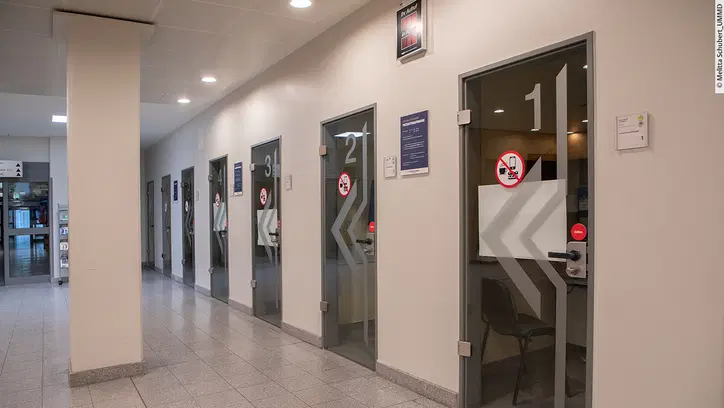
The participants also modified the hardware infrastructure: The intake booths were equipped with monitors and sign pads with pressure-sensitive pens on the patients’ side. These devices were connected to the staff members’ computers. With the Thieme application Documents Desk, healthcare professionals and patients see personalized versions of the documents. “I read the text aloud and fill out the admission document based on the information provided by the patients. This allows me to control the pace and systematically guide patients through the process until they provide a legally valid signature,” explains Linda Jäkel. The document is then saved in the system and is available throughout the hospital as a PDF document in the hospital information system (HIS).
An Overview of the Benefits of the New Process
The introduction of digital patient registration brought numerous benefits to Magdeburg University Hospital:
- Simplified handling: No more paperwork – documents no longer need to be sorted or searched for. Patients are relieved of the burden of carrying and keeping paper documents on hand.
- Time savings: The admission time per patient has dropped from 15–20 minutes to 5–10 minutes. The time saved is redirected to other important tasks, such as correcting erroneous entries in the system or having central admissions staff complete admissions on the wards.
- A More Personalized Patient Intake: The time saved allows for conversations with patients, which enhances their well-being. “And seeing this effect also makes our work more enjoyable,” says Jäkel.
- Cost savings: The cost per admission has dropped from 4.40 euros to 44 cents – a 90 percent savings, primarily due to reduced personnel and material costs.
- Immediate Data Availability: Admission data is available as a PDF in the HIS. All departments have immediate access, which optimizes communication and eliminates the need for follow-up inquiries. This facilitates aspects such as treatment planning, billing, decisions regarding additional services – such as private rooms – and the use of pseudonymized patient data for research.
- Sustainability: Eliminating paper and printing helps reduce resource consumption and promotes the hospital’s environmental sustainability.
Training and Pilot Projects for the Digital Process
Once all prerequisites had been met, the entire admissions team completed training on the new process. Linda Jäkel took on the role of motivator: “Since I was really enthusiastic about the idea of switching to digital, I was able to win over skeptical colleagues and allay their fears. I emphasized that the new solution is easy to use and that nothing about the content has changed.” In fact, after just a few practice runs, all employees were familiar with the procedures.
After the training, Jäkel conducted a pilot test on her own, during which she digitally registered patients in her office. “Many had already signed documents digitally before – for example, at the supermarket or the bank – and found it convenient to simply read along and provide information verbally.” Patients are offered the option to receive an encrypted copy of the documents via email instead of a printed copy. “Even very elderly patients often have an email address and agree to this,” says Jäkel. The password to open the email is provided to them on-site.
Following this pilot, the entire admissions team began using digital patient admissions in late 2023. The process has been running smoothly ever since, with only minor technical hurdles that the team was able to overcome using the old paper-based process. In the meantime, eight wards have also been equipped with the digital solution to enable more efficient admission of patients, such as those arriving from the emergency room or who are bedridden.
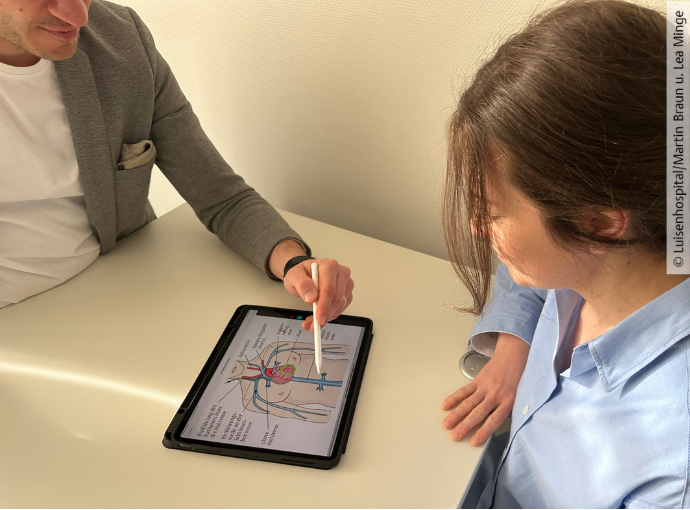
The admissions staff explains the contents of the form to the patient at the bedside using a tablet, asks the patients for the necessary information, and fills out the document. The patients then sign the form on the tablet. “Admissions are not part of the core duties of specialized nurses. That’s why they appreciate the clarity and simplicity of the new process all the more,” says Franke.
Outlook: Mobile Solution
” The next steps are already in the planning stages. Together with Thieme Compliance, we are currently developing a mobile solution that allows patients to enter their admission information at their own pace at home and submit it to the hospital. This will make the process more efficient, as our staff will be able to conduct the admission interview with greater focus,” explains Martin Franke. A few questions still need to be clarified, such as whether patients should sign the document at home or review it one last time with the admissions staff before signing.
All in all, the “Paperless Patient Admission” project at Magdeburg University Hospital demonstrates how digitization can be successfully achieved through innovative technology, comprehensive planning, and dedicated staff. And it disproves the misconception that technology replaces people – on the contrary: it creates space for the human connection that is so important in the healthcare sector.
Magdeburg University Hospital
The Magdeburg University Hospital is one of Germany’s leading institutions for comprehensive medical care, teaching, and research. In addition to its main campus on Leipziger Straße, the hospital includes the University Women’s Clinic and the Training Center for Healthcare Professions. With 1,100 beds, state-of-the-art medical technology such as PET-CT and INTRABEAM, and interdisciplinary collaboration, it ensures patient care of the highest standard. With approximately 4,800 employees – including doctors, researchers, nursing staff, and administrative personnel – Magdeburg University Medical Center is one of the largest employers in the region.