
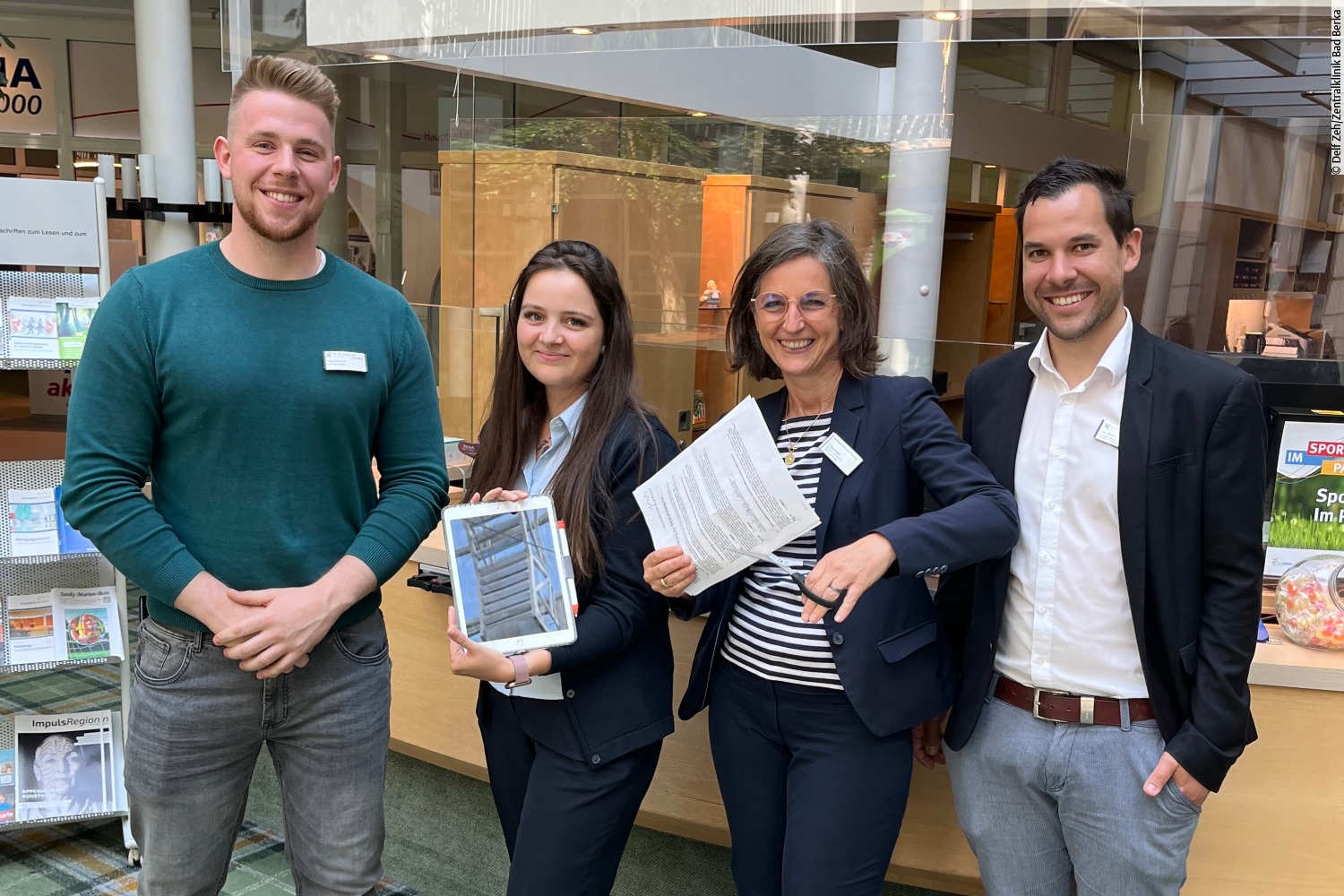
Bad Berka Central Clinic Adopts Paperless Patient Registration
The Zentralklinik Bad Berka has taken a groundbreaking step toward a smarter future by introducing a fully digital patient admission process. Patients can complete their admission on a digital device, either at the front desk or directly at their bedside with the assistance of a healthcare professional. All information is stored centrally and can be accessed digitally at any time, eliminating the need for paper. This innovation, developed in collaboration with Thieme Compliance, significantly optimizes the workflow.
What challenges did the transition to paperless patient registration entail? How do staff and patients benefit from it? What are the joint plans for the future of RHÖN-KLINIKUM IT-Service GmbH and Thieme Compliance? Christoph Müßig and Frank Ziegler – Commercial Product Manager and Sales Solution Manager, respectively, at Thieme Compliance – as well as Julian Schäfer, Team Leader for Medical Specialty Systems & eHealth at RHÖN-KLINIKUM IT-Service GmbH, and Philipp Hofmann, IT Project and Application Manager for Medical Specialty Systems & eHealth at RHÖN-KLINIKUM IT-Service GmbH.
Mr. Schäfer, what was the deciding factor in your decision to work with Thieme Compliance to implement a fully digital patient registration system at the Zentralklinik Bad Berka, which is part of the RHÖN-KLINIKUM AG network?
Schäfer: We’ve been in a development partnership with Thieme Compliance for several years now. In early 2023, we successfully implemented paperless patient registration at the Frankfurt (Oder) Hospital. Our goal is to continue digitizing all RHÖN-KLINIKUM locations in collaboration with Thieme Compliance. Therefore, the decision was an obvious one.
How did the hospital staff react to the decision to make patient admission paperless?
Hofmann: At first, there was naturally some skepticism, as with any change. Concerns centered mainly on the fact that the new processes might take more time. Constanze Mayrhofer, the head of patient admissions in Bad Berka, did an excellent job of involving and motivating the staff, however. She emphasized that the new IT solution is easy to use, even for staff and patients with limited digital experience. As a result, the initial doubts quickly faded.
How Digital Patient Registration Was Successfully Integrated Into the Hospital’s IT System
What were the biggest challenges in integrating the fully digital patient registration system into the hospital’s existing IT infrastructure?
Müßig: One of the biggest challenges was correctly importing the relevant data fields from the hospital information system (HIS) into the intake forms in the E-ConsentPro software. The goal was to automatically populate the intake form with existing data, thereby eliminating redundant data entry and documentation. To achieve this significant added value, we discussed the procedure in detail. Data protection also plays a central role. The security requirements are high. We had to ensure that a log is created in the background for every document processed, which precisely documents when and what happened to the document, which steps were completed, and which employee processed the documents. The log is visible only to administrators and is used solely for emergency purposes. Additionally, all documents are protected by two-factor authentication when sent via email to patients.
Schäfer: With support from the Thieme Compliance content team, we have digitized all forms over the past six months and tailored their content to our clinic. Our development expert, Frithjof Eckhardt, played a crucial role in analyzing the data fields and configuring the interface. Using an internal mapping table, we were able to determine which data fields we needed for the admission documents. It became clear whether the data fields were available in the hospital information system (HIS) or needed to be specially prepared. Ultimately, we successfully imported over 30 data fields, including referring doctor, specialist, insurer, next of kin, phone numbers, and consent forms.
What was the setting like in the pilot episode?
Schäfer: Just as we do now during regular operations. For patient registration, we use freestanding monitors in enclosed booths, as well as a larger public counter with horizontal 10-inch monitors and signature pads. We opted for this relatively small display size in the public area so that personal data would not be visible to other patients. In addition, we’ve implemented a mobile patient registration system for bedridden patients or those in the emergency room, for example. In this process, the admission staff asks the relevant questions directly at the patient’s bedside, enters the data digitally into the hospital information system (HIS), and has the patient sign the consent form on an iPad.
Hofmann: Once signed, the documents are archived in iMedOne on a case-by-case basis. They are then available digitally to the relevant departments and administrative offices as needed. Patients receive the documents via email. In addition, they are provided with a password to open the documents, which are protected by two-factor authentication. We give each patient an information sheet that explains the process with simple instructions.
Positive Response to the Pilot: Feedback from Patients and the Team
What was the patients’ experience with the pilot program?
Hofmann: They’ve responded positively to the paperless process – across all age groups. The first patient we enrolled was over 80 years old. She immediately pulled out her smartphone to check the copies of the contracts in her email inbox. Many of the patients admitted were already familiar with electronic signatures, whether from banks or the postal service. Even for patients with limited digital literacy, the new IT solution was easy to use. Since everything runs automatically, the workflow is simpler than before. Furthermore, patients no longer have to carry paper documents around with them and constantly make sure they have them on hand.
And what about the employees’ experiences?
Schäfer: The employees quickly became familiar with the new processes and reported back to us the benefits we had hoped for: The automatically pre-filled patient master data and consent forms reduced the workload. Staff no longer have to print, scan, or compile documents, which also reduces the risk of losing records. Problems such as illegible handwriting or wear and tear are now a thing of the past as well.
Efficiency and Stability: Insights Following Implementation
Can the time saved be quantified?
Hofmann: Time is saved by eliminating the need to digitize paper documents. The actual time required for patient registration is roughly the same, so it is difficult to quantify the exact time saved.
Has the process been running smoothly up to today?
Schäfer: Since the pilot program, the process has been running smoothly and has become the standard. There have been only a few minor adjustments, such as adding new data fields. Employees are becoming increasingly accustomed to performing all tasks digitally. The more this process becomes second nature, the more time is saved.
Future Plans: More Self-Service and Digital Processes
What are the other plans we have together?
Schäfer: We are currently working on implementing paperless patient registration at the RHÖN-KLINIKUM Campus Bad Neustadt. With each subsequent adjustment, we’ll draw on the experience we’ve gained from the clinics that have already made the transition. Our close collaboration with Thieme Compliance helps us find practical solutions to complex issues.
Müßig: At present, RHÖN-KLINIKUM IT-Service GmbH is our closest partner in the ongoing development of the digital admission process. We greatly value this intensive collaboration. After all, we can only advance our products as far as our customers allow through their openness and commitment. I would describe the data import from the hospital information system (HIS) and the customizable design of the digital admission documents in particular as flagship projects.
Ziegler: Our goal is to enable more self-service in communication between the hospital and patients. We want to empower patients to easily carry out on their own a number of communication processes that previously required staff assistance. To this end, we aim to develop effective solutions in a customer-focused and agile manner – for RHÖN-KLINIKUM AG and other partners.
Author: Dr. André Gärisch